Meanwhile With Trevor
Culture • Lifestyle • Fitness & Health • Movies • Books • Food
Reagan, Rambo, and What's Downstream of What
July 07, 2023

Bob Dylan said, “We live in a political world.”

That was in 1989 and I fear it’s only gotten worse. When Indiana Jones and the Dial of Destiny came out last weekend the question on the minds of many was, “Is it woke?” But when Raiders of the Lost Ark came out in 1981 I suspect the only question being asked was, “Who is this guy?” No one worried about the politics that may or may not have been inserted into the story. He punches Nazis, ‘nuff said. 

As the meme says, we used to be a proper country.

It seems to me, someone who just barely qualifies for Gen-X, that our last president who was really in tune with the culture was Ronald Reagan. Sure, Bill Clinton played the saxophone on late night TV for all that’s worth. And Obama was adored by Hollywood and got a Netflix deal out of it. Trump? He was made by the media and used it against them.

But Reagan loved movies. 

On July 1, 1985 the Los Angeles Times reported that, while preparing to address the country regarding a recent hostage crisis, the then president said, “Boy, after seeing Rambo last night, I know what to do next time this happens.” It’s entirely possible that once Reagan’s remark got out it helped Rambo: First Blood Part 2 at the boxoffice. Still, it’s worth noting that this is a now rare example of politics reacting to pop culture in a positive way.

"Do we get to win this time?"

Reagan wasn’t at war with Hollywood or the American people. He was sitting in front the movie screen, like us, finding entertainment and inspiration. Like us. The dominate media of the time wasn’t a cudgel or a force to bent for his own ends (like the current administration has attempted to do with social media). Rather, Reagan was engaged with the culture and celebrated the things he enjoyed.

His many movie references are legendary. 

We don’t see that much anymore. Everything is political, and politics corrupts everything it touches. The beauty of a thriving culture is that is that it sustains itself, builds momentum, and grows. It can also make fools of those who use it without understanding. Cory Booker’s “I am Spartacus” moment, anyone? Booker beclowned himself by trying to make himself the hero. Reagan said he was inspired by the hero.

Therein lines the difference.

Movies today don’t have inspirational, virtuous men. In the hands of Disney, men are made of straw for executives to pummel with their meaningless arguments. I’d like to see a real action hero and know that a candidate took the same joy and inspiration from the story as I did. But as long as we don’t have stories worth remembering, neither will we have a society worth celebrating.

Politics is downstream of culture.

community logo
Join the Meanwhile With Trevor Community
To read more articles like this, sign up and join my community today
0
What else you may like…
Videos
Podcasts
Posts
Articles
Tuesday Update

New article is on the way, but I'm feeling too overwhelmed to crank it out.

00:01:17
Update!

I cover it in the the video, but I've got some new professional writing opportunities coming up and I'm trying to finish my next novel, all while navigating a change in schedule. So look for more pictures and videos, and new articles here on Tuesdays and Thursdays.

00:02:47
He Who Rides on the Clouds - Conclusion

Leo and Britt come face to face with a prehistoric god a new cult on Saturn. Can they save the children doomed to sacrifice and escape?

He Who Rides on the Clouds - Conclusion
He Who Rides on the Clouds - Part 2

Leo and Brittany have arrived on Saturn, but not in the way they'd hoped. Captured by a pagan cult, they don't have time to stop the unthinkable from happening. But they'll try anyway.

Content warning: language and sexual situations.

He Who Rides on the Clouds - Part 2
He Who Rides on the Clouds - Part 1

Star Wars is dead and the more apathy you show the faster it will be allowed to rest in peace.

Instead of griping about what Disney has done, why don't you listen to my space adventure story? He Who Rides on the Clouds is supernatural noir that spans space and time. When children on Mars go missing, Alexis Leonard and his ex-wife Brittany go looking. Their search leads them to a pagan temple and an ancient religion.

If you'd like to buy the story and read ahead, it's available in the Fall 2020 issue of Cirsova, available here: https://amzn.to/3yRRywY

He Who Rides on the Clouds - Part 1
post photo preview
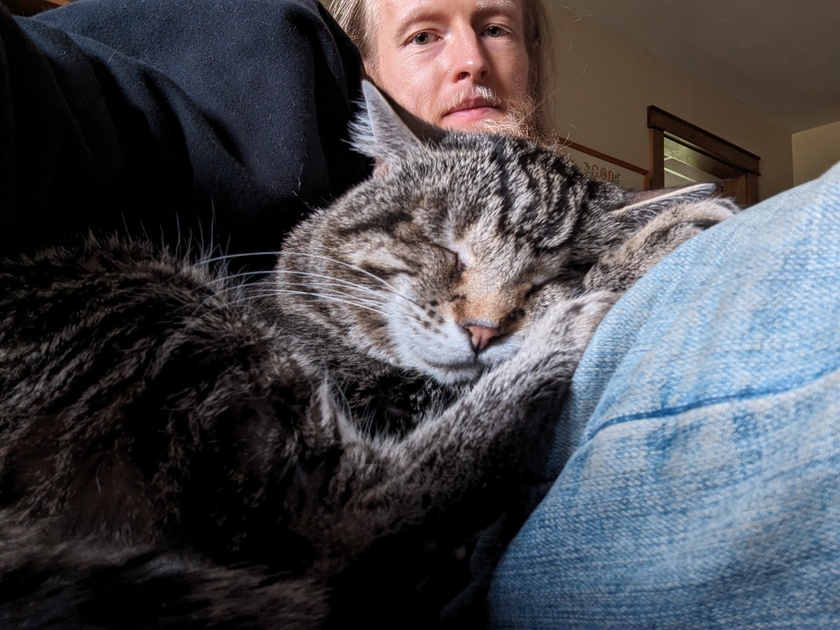
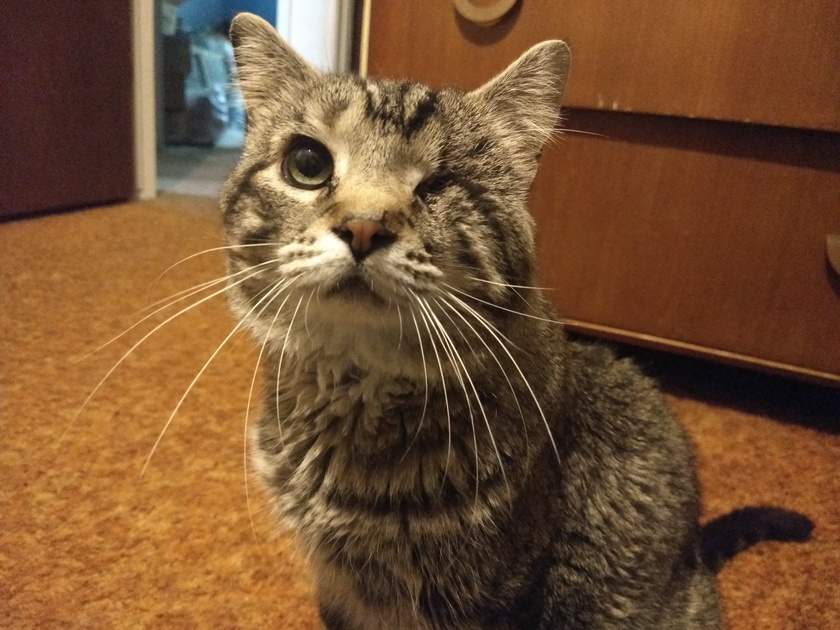
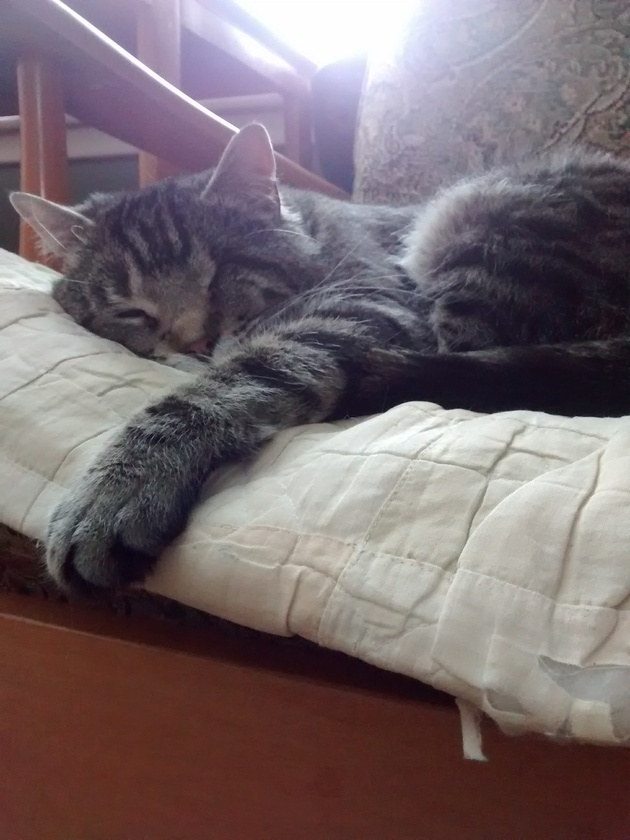
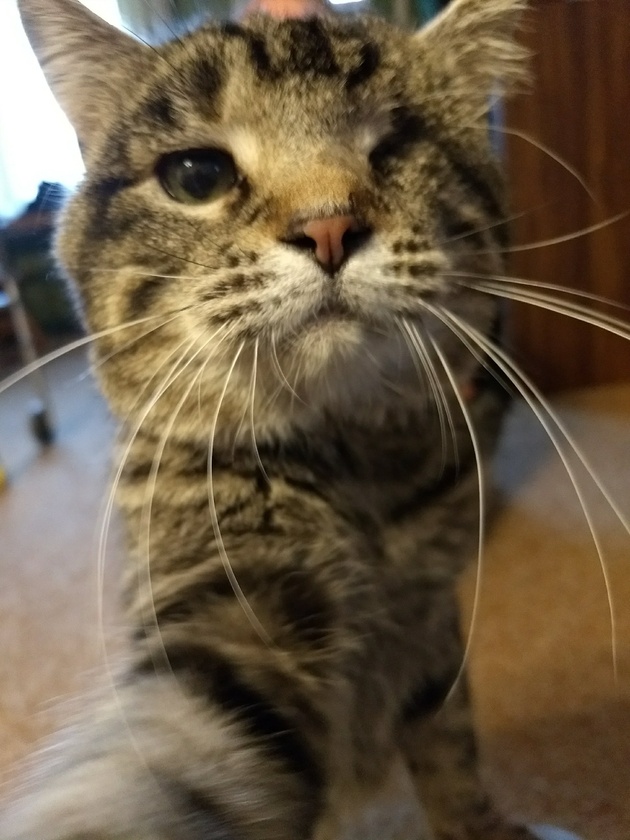
Willy, The Unforgettable Old Cat

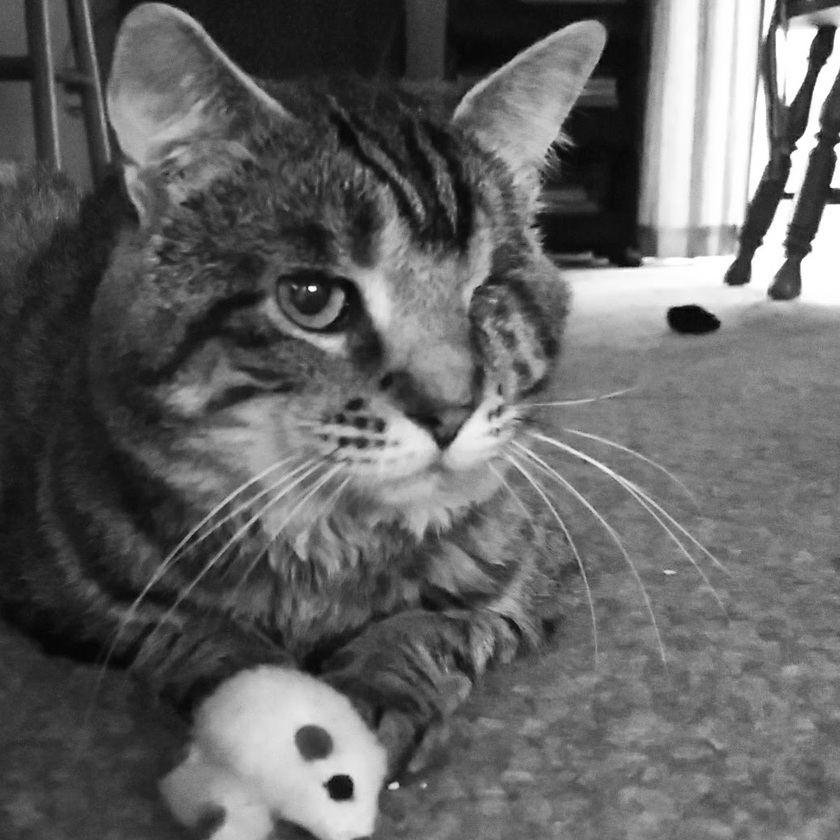
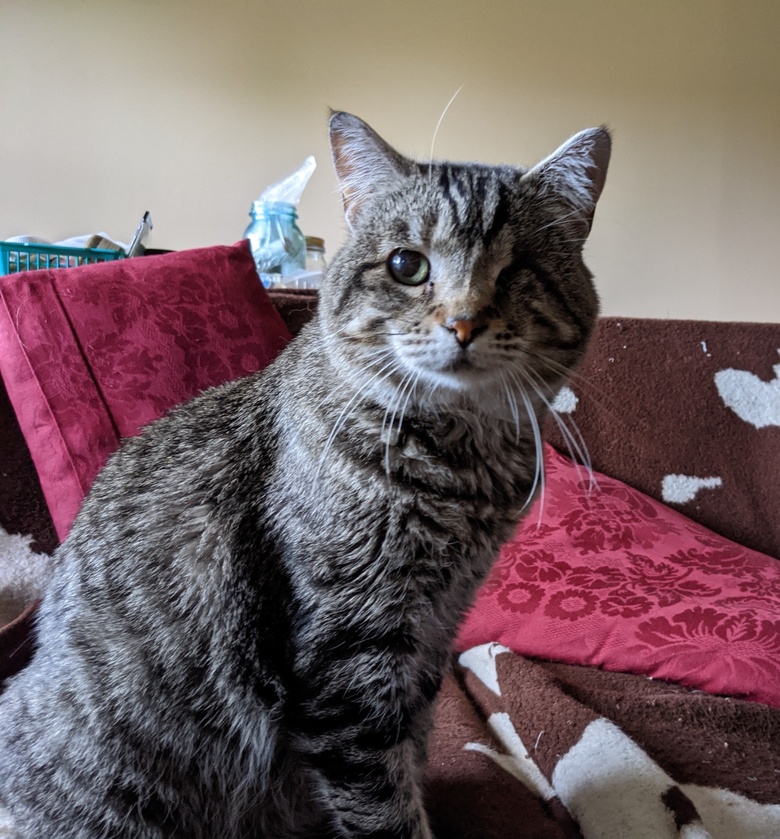
Willy, affectionately known to many online as “the old cat,” was a character. He had more personality than any other cat I’ve ever met, and even the staff at veterinary clinics commented on his sweet disposition. At times he was anxious, at others he was affectionate, and at others he was just a pest.

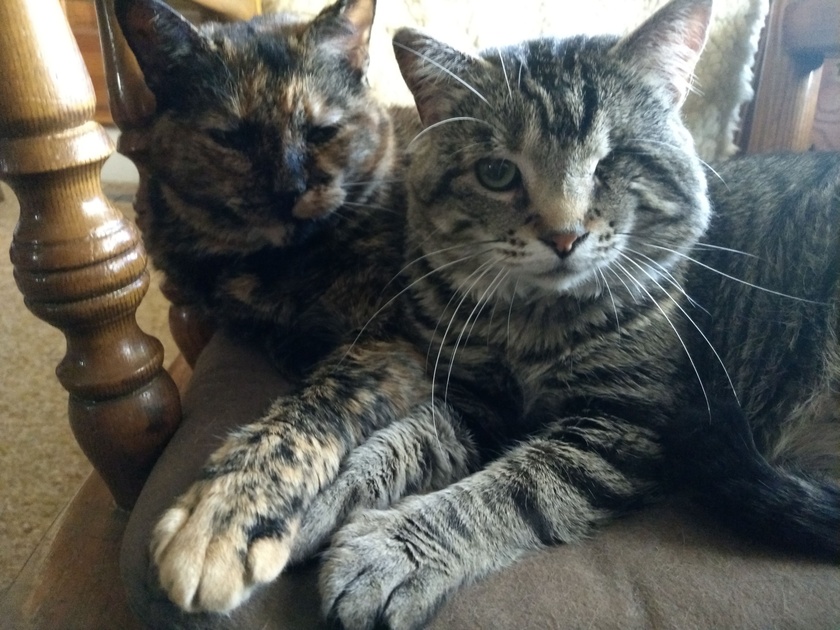
When Willy came into my life, I wasn’t looking for a pet. But my sister felt that our mother and I needed some company. Together, the two of them conspired to bring two cats home from the Humane Society while I was at work. One night, I came home and was told to go down to my sister’s old room. And there they were, Willy and Trudy.


As far as we know, Willy and Trudy were rescued from the house of a hoarder. I don’t know how long they were in rescue, but I believe that it shaped Willy’s personality. Yeah, he was needy. If he saw me putting my shoes on, he’d come over to discourage me from leaving by pawing at my hands. Like a puppy, when he heard the door he’d run to see who was there to see him.

He was never shy.

They were something of a mismatched pair. While Trudy was fat, Willy was lean. While Trudy was a tortie and shy by nature, Willy loved being the center of attention. He’d ham it up for company. Always very fastidious about his grooming, he never let the fact that he only had one eye and no teeth affect his vanity. The only thing having no depth perception affected was his willingness to jump on things.


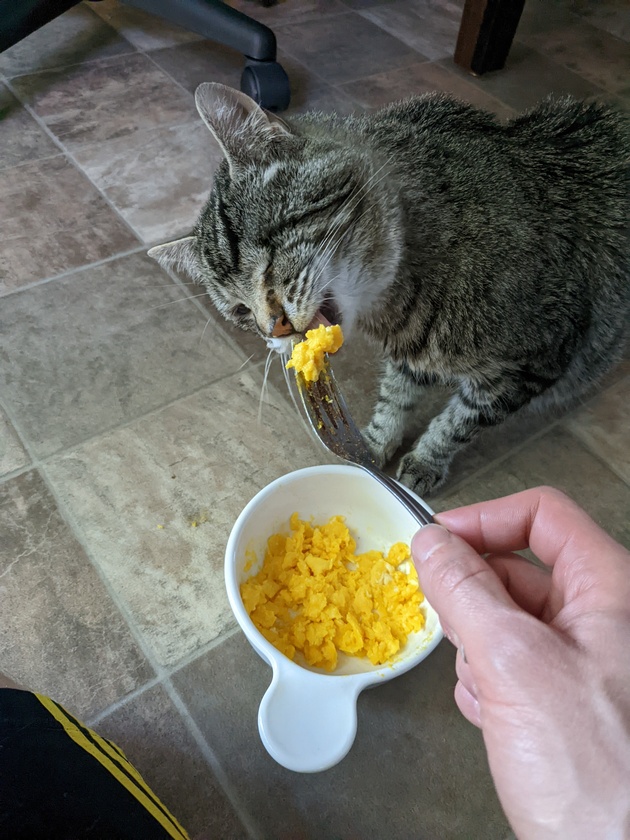
Even without teeth, Willy preferred dry food. But what the little guy really loved was scrambled eggs. In the morning, he wouldn’t settle down until I’d shared some with him. He’d hear me scraping up his portion on my plate, and start poking my leg to tell me to hurry up. 


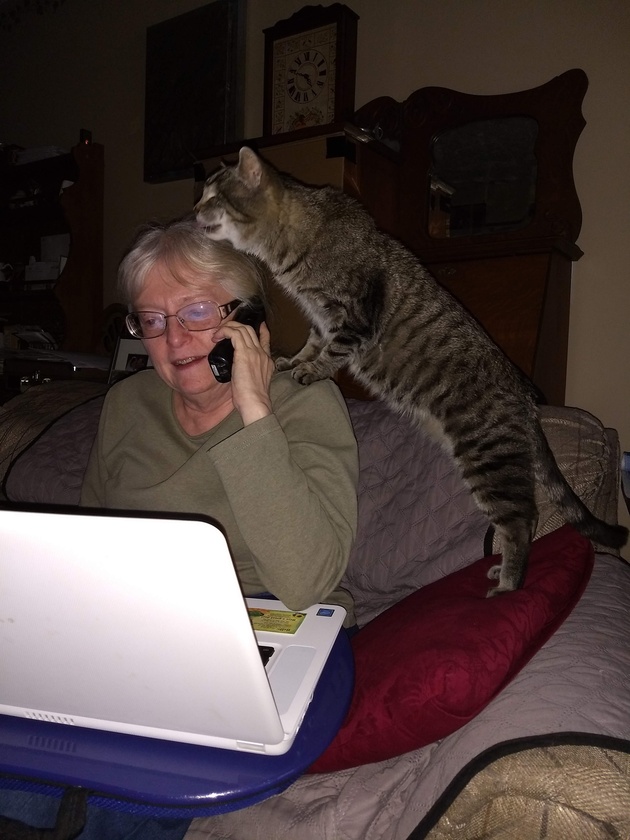
When he was really hungry and in a mood, though, Willy had another way to communicate. He would lick things: walls, cushions, spiderwebs, and, if that didn’t work, he’d climb up on your head and start licking your hair. Sometimes, he’d give a warning jab first. And then he’d come in with his tongue. 


There were many nights over the years that I had to sit up with him and watch him eat. He wouldn’t always go to the food dish when he was hungry, but come find me instead. I’d have to move the cat or the dish, and stay to watch. This continued even through his final weeks.

Unfortunately, Willy’s stomach was often empty. I called him “the vomit barometer,” because every time the weather took a dramatic change he’d throw up. I’ve joked that now that he’s gone, I’ll save a fortune in paper towels. For a while, scrambled eggs seemed to be the only thing he could keep down consistently.


Later, we had to put him on a strict prescription diet and give him monthly B-12 injections. Willy had the kitty herpes, so no immune system. He also developed inflammatory bowels, so no foreign proteins. For most of his life, he had a heart murmur that made me fear he’d have a painful blood clot. Towards the end, as is usually the case with old cats, he had chronic kidney disease. But he didn’t know he was sick and dying. The only health challenge that defined him was the throwing up.


Maybe his vomiting was some sort of anxiety response. Over the years, he had his share of worries. When we first got him, Willy would pace in circles. One night, he got so upset he peed all over my Blu-Ray collection. He and Trudy had a big falling out one spring, and she was afraid him. I had to keep them separated for weeks, and the only thing that got them back together was several months of Xanax.

Ironically, travel was never a problem. The day we moved, I foolishly thought he’d ride in a carrier. My sister had him in her car. From the driveway to the end of the street wasn’t far, maybe a 30 second drive. In that time, he escaped. That was the day we learned that he’d travel just fine sitting on floor. Willy didn’t like going for rides, but he’d deal with it quietly.

We had to say goodbye to Trudy almost exactly two years before Willy followed. March, it seems, in a season of endings in our home as much as it’s a season of new life outside. Willy spent a few days looking for her, but on some level I think he knew she was gone.


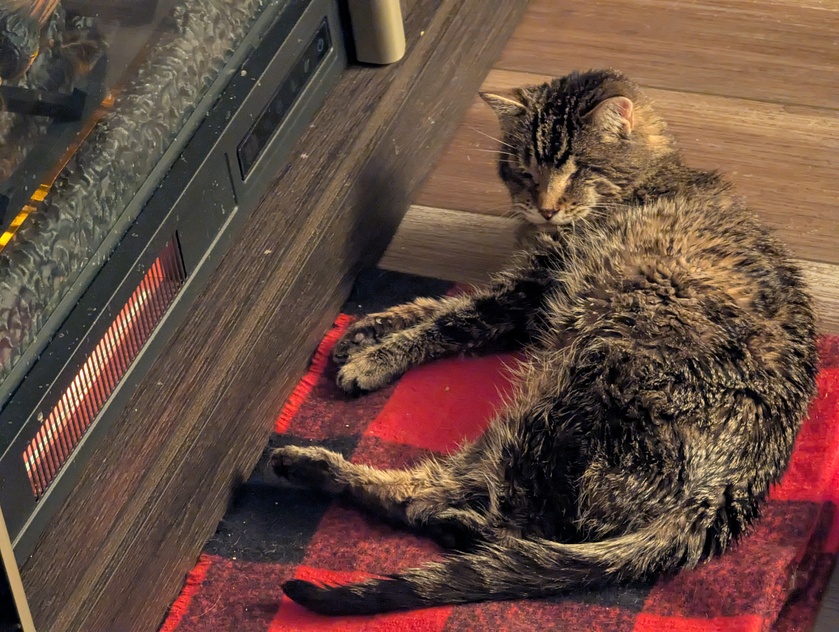
In the winter, the old cat loved sleeping by the electric fireplace. If I turned it off before he was done with it, he'd let me know with a stern a look before moving and sitting in front of the vent.

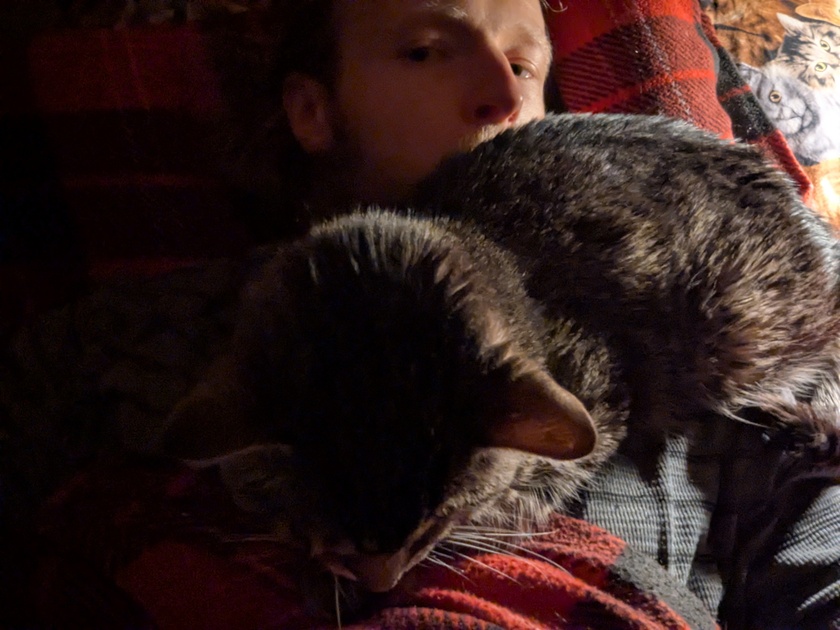
At night, he liked sleeping on my neck. I'll miss that.

When God was handing out sets of nine lives, Willy got in line three times. There were so many moments when I was sure it was the end. But he just kept coming back. Even the day I finally decided I had to let him go, he was gamely trying to hold on. That morning, he had a seizure. Twenty minutes later, he’d walked it off and was in the kitchen having a drink and sitting the sunshine. 

My prayer had always been that in the end, Willy wouldn’t be in any pain, that he wouldn’t be afraid or suffering. But the seizure settled in my mind that we couldn’t risk another one. We went to the emergency vet at MSU, and they gave me time to hold him and say goodbye. It was the very same room in which I’d held Trudy not too long before. He wanted to get out of my arms and explore. They gave him the first injection, to put him to sleep. Willy’s last moment was sitting up to squirm. Then… he relaxed.


That may sound heartbreaking. But I know in my heart that it was his time. His final effort to move, explore, and socialize, and that just told me my prayers had been answered. He wasn’t in pain, and he wasn’t afraid.


Without my realizing it, I’d conveyed so much of Willy’s unique personality to my friends online that they shared in my loss. Some pets are just pets. Willy, the old cat, was something just a little more. I truly believe that the God who created that very special personality and allowed me to love him so much, will allow me to see him again in Eternity. Maybe I’m wrong, and in Heaven it won’t matter. But for now, the idea gives me some comfort and hope. 

Goodnight, Old Man. I'll miss you.

Read full Article
post photo preview
No Budget, No Gatekeepers, No Problem: How AI Is Democratizing Storytelling

Story never changes. At its core, every story dramatizes the hero’s eternal struggle between order and chaos — whether that conflict comes from nature, other men, God, or himself. But every so often, the medium for storytelling takes a huge leap forward. We’ll never know the epics that preceded that of Gilgamesh and the idea of putting fiction on clay tablets. Before that, stories were as effervescent and intangible as a whisper by a campfire. Just as fleeting, in some ways, were the plays of Shakespeare and his actors, and the Greeks before them.


Printing presses allowed a single author’s vision to spread, giving the world Don Quixote, Robinson Crusoe, Superman—and all the long-form literary fiction we take for granted today. Radio shows briefly took us back to “those thrilling days of yesteryear!” when motion pictures and TV were still luxuries. They were the evolution of the oral tradition, with the addition of dramatic music and sound effects, recorded for posterity. Today, most of us carry in our pockets devices that can hold thousands of books, or used to write one. Smartphones can show us movies, produce movies, and instantaneously share those movies.


Ironically, more than ever it seems like a good story is hard to find. The multi-billion dollar monolithic movie studios and publishers churn out hours of fresh content daily. No less prolific, given the sheer volume of them, are the independent artists, most working “real” jobs to pay the bills. They go largely unnoticed. Unless you’re directly involved, you may not realize how expensive it is to make something that looks and feels professional. There’s a reason Hollywood pours hundreds of millions of dollars into a single movie — they set the standard. There’s a reason indie films lean into esoteric artistry — no budget means no special effects, no recognizable locations, no union labor.


The Hollywood Bottleneck

The Hollywood machine has tar in its gears. Writing an amazing screenplay can take several weeks (if the legends are true). But getting it noticed by the right people can take decades — if it gets noticed. Then there’s the endless tinkering before production — if it’s produced. And should you ask anyone who’s been on set what making a movie is like, they’ll tell you it’s a lot of sitting around waiting. Lights and cameras have to be moved, makeup needs adjusted, endless minor details discussed. Actors are temperamental. Then there’s the editing, test screenings, and producers’ notes. 


After going through so many filters, by the time a completed film arrives in theaters it’s homogenized and sterilized. The original idea that started it all is emulsified. And now, the industry is calcified. Worst of all, the average American finds his entertainment fortified (a nice word for polutifed) with an agenda antithetical to the reality he knows. 


Galaxies in a Dewdrop

What if there was a way to remove budgetary shackles and create nearly at the speed of thought? What if instead of a series of writers, producers, studio heads, actors, directors, and focus groups, movies had a single vision? And what if that sort of power was given to an ordinary guy with an extraordinary imagination? That would be very dangerous to the cultural gatekeepers, and a good story might not be so hard to find.


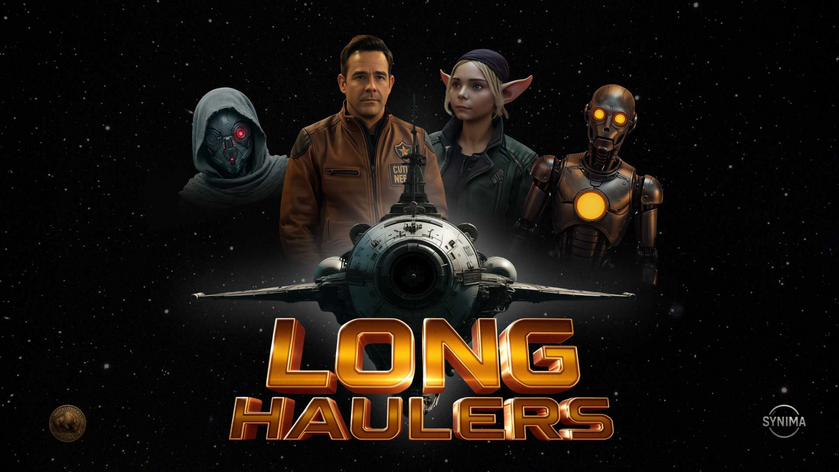
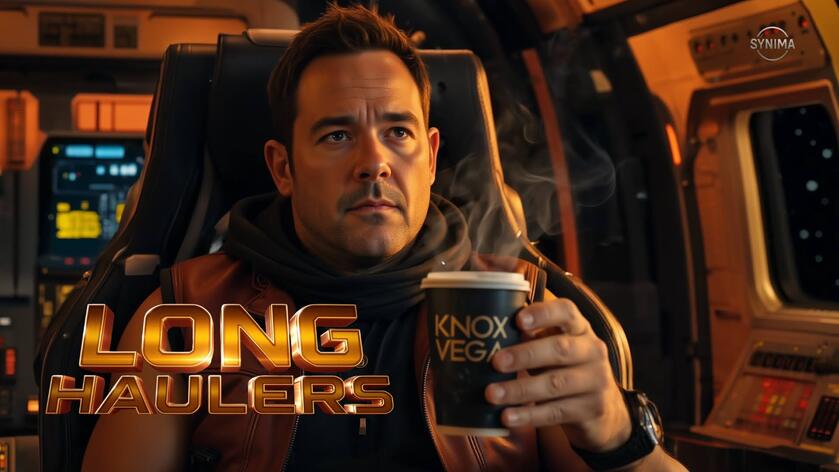
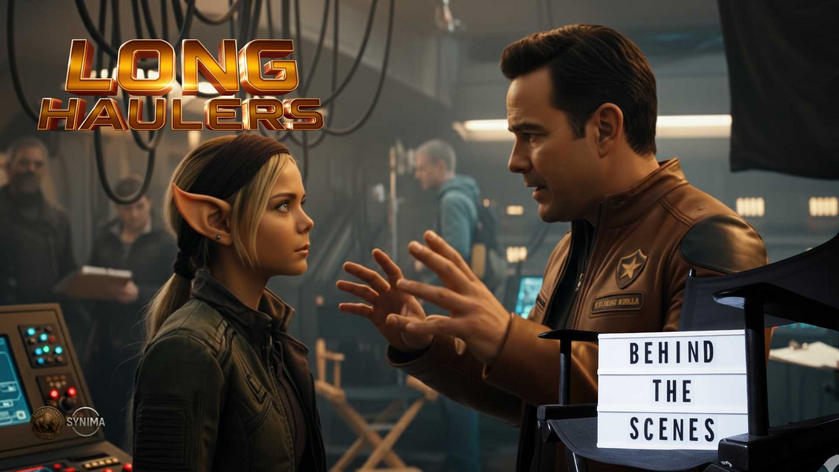
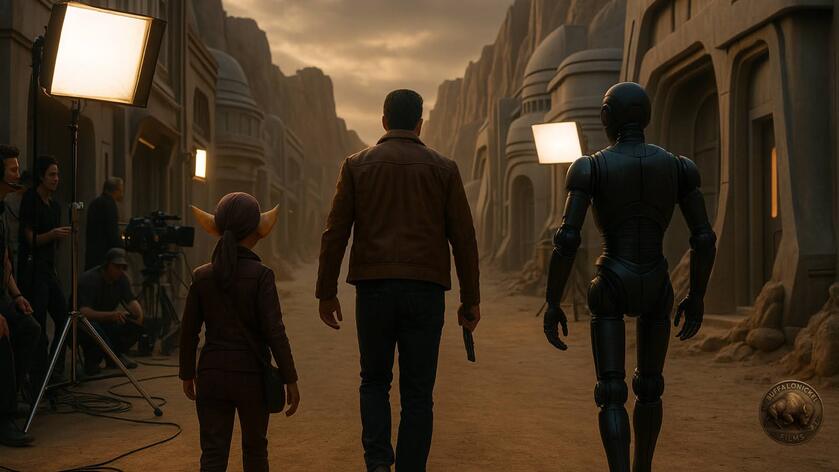
Michael McGruther is an ordinary guy with an extraordinary imagination, and thanks to developing AI technology, he’s creating the stuff of Hollywood’s nightmares and the everyday American’s dreams. His MacBook Pro is not only his writers’ room (where he meets with his writing partner, ChatGPT), but also his studio, backlot, editing suite, special effects house, and the honeywagon for his “actors.” With all these resources available, his is the singular vision behind Long Haulers.


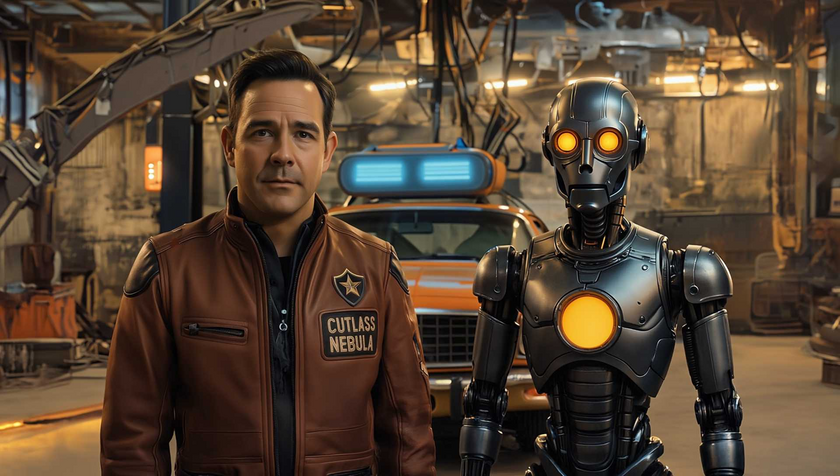
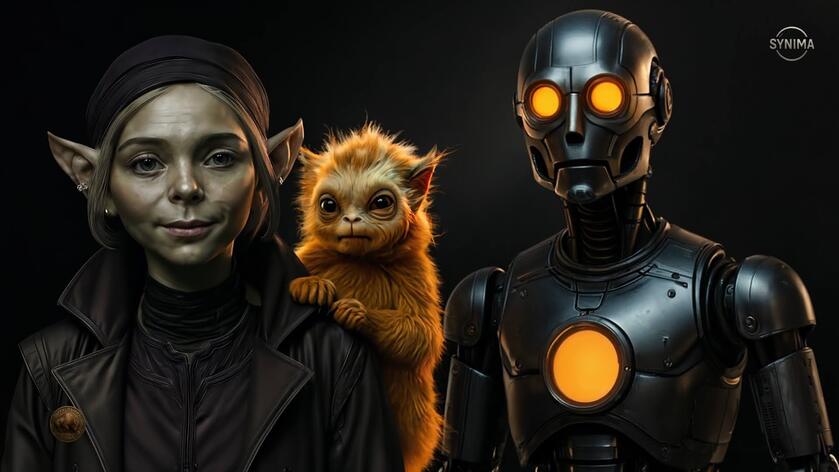
What started as an experiment with AI animation and an idea to make the opening credits to ‘80s-style sci-fi sitcom blossomed into a weekly web series. Long Haulers is the story of Knox Vega (who looks just like McGruther, so don’t come after him for stealing a celebrity’s likeness or try to borrow it for yourself), an interplanetary deliveryman on a mission. When all the jobs on Earth go automated, Knox has two choices: get drunk, or find a job with a purpose. Thankfully, he chooses the latter, accepting responsibility of the S.S. Grit and its cargo. With the help of the ship’s Virtual Integrated Research Assistant (VIRA, for short), who appears as a beautiful woman, he goes on a journey. 


Each episode is written as a visual novel after conversing with ChatGPT about the plot. The AI isn’t creating the story, though, simply amplifying and clarifying McGruther’s ideas. If he needs market research to know what his audience likes, he can get that too, along with suggestions for incorporating those things into his story. While Disney is probably spending upwards of a million dollars (budgets are not known) per animated Star Wars episode, producing an episode of Long Haulers is probably closer to what you'd spend on dinner and a movie.


Codes: Computer and Moral

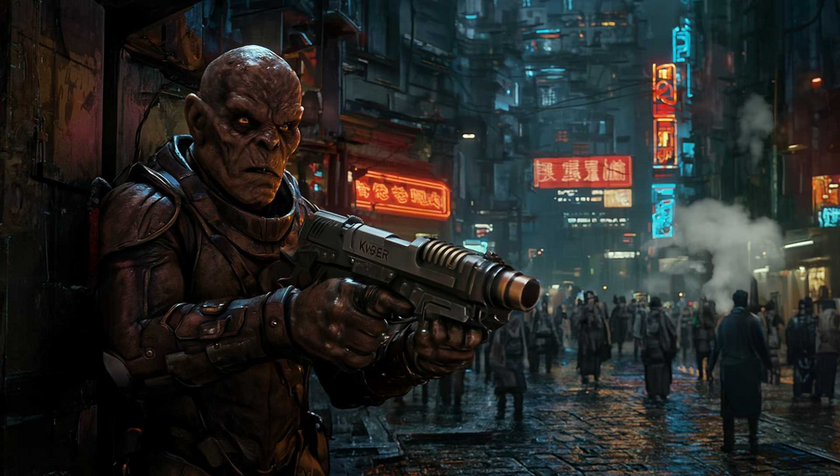
If your only experience with AI-created content is what you see on TikTok, it may seem trite and soulless. Admittedly, as we're still finding our way out of the uncanny valley, there’s still something a little “off” about these not-quite-human digital puppets. What sets Long Haulers apart, and sets all great stories apart, is intent. Unlike the viral TikTok reels, Long Haulers is more than a meme. Through the power of story, McGruther has something to say.


Long Haulers is indifferent to politics and preaching, and just puts Knox into situations where he must live out his beliefs. Ultimately, a character is a character, whether he’s described in words, played by Tom Cruise, or generated out of ones and zeros. Characters have moral codes, and in each episode Knox is driven by his own.


Trailblazing

Just as Knox is modeled on McGruther, more AI stars will be actors, who are working hand-in-hand with the storytellers. The pay may not be as spectacular, but the freedom and reach will be incomparable. Even now, the studios and talent agencies are scrambling to claim a stake in this new frontier. Can they sign an AI actor? Perhaps. But will real actors who can digitize themselves still want or need contracts and agents? It will depend on what they value: Freedom or Security.


Speaking of values, are Knox’s values (or for that matter, McGruther’s) our values? That’s something we’re invited to consider. McGruther shares what he believes through his art, and we can take it or leave it. So much coming out of Hollywood is a lecture from a soulless corporate collective. Worse yet, these lectures lack the conviction to look us in the eye, because the corporations are forever looking past the audience to the next bit of content they're going to sell. Long Haulers doesn’t tease us with the next thing. It is the thing. We’re invited to engage with the story to further refine what we feel and believe, just as McGruther interacts with ChatGPT to refine his narrative. 


Looking Ahead

Will Knox Vega stand alongside Gilgamesh, Don Quixote, Macbeth, or Superman? Perhaps, perhaps not. Knox isn’t a complex character, and that’s the point. He was created organically, and his stories, despite the assistance of AI, don’t feel artificial. McGruther’s genuine passion for storytelling and belief that we can have a culture that heals rather than destroys comes through. Are there imperfections? Of course. Because McGruther, and every storyteller but God, is imperfect too.


Make no mistake, this is a landmark moment in storytelling. Without AI, we’d never be able to see the universe of Knox Vega as McGruther envisions it. A studio like Disney would never pour Star Wars money into such a project, and a novel, no matter how skillfully written, can only convey so much. In the early days of computer animation, Kerry Conran, director of Sky Captain and the World of Tomorrow, spent four years on a six minute short that eventually got Hollywood’s attention. If he’d had access then to the tools McGruther has now, he could have achieved that in an afternoon—and made his feature without leaving his Michigan home. 


Hollywood’s golden age was filled with stories written and produced by war heroes, refugees, those who grew up poor in cities and on farms. Now it’s filled by those who grew up in a bubble devoid of real-life experience. The new advances in technology allow (not will allow, but do allow, right now) talented, everyday folk to tell stories with all the organic authenticity audiences have missed. Whether or not Hollywood survives is irrelevant. A new culture is here, and good story won’t be so hard to find. 


Read full Article
post photo preview
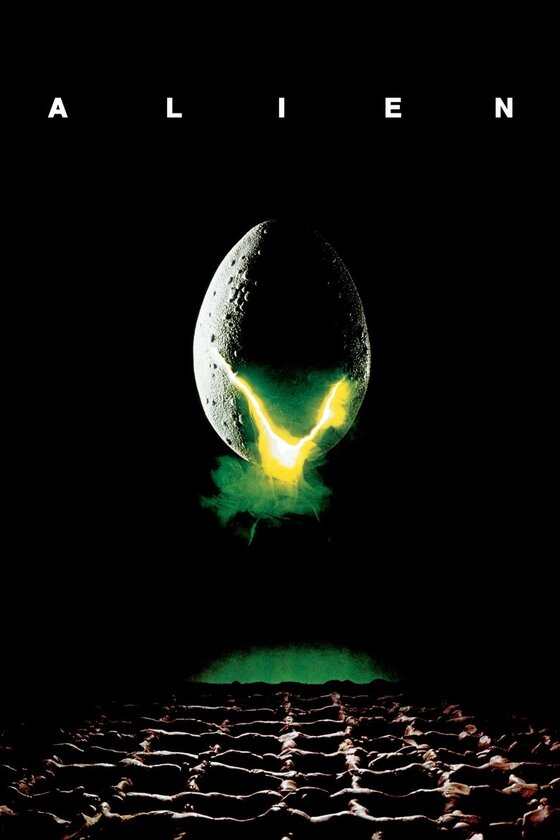
Alien (1979) Movie Review

It'd been about 20 years since I last saw Alien, and then it was only because a roommate demanded it of me. I've never gone further into the franchise.

We've been trained to go into every movie as if it's an amusement park. There was a time (and Alien is a prime example) when movies were approached as art exhibits. Yes, Alien has moments of horror. But it's not primarily a horror film designed to carry us on visceral reactions. Instead, it's a finely tuned suspense movie.

In every frame there's something to consider. It might be the characters, how their unique motivations and personalities draw different things from the others. It might be the texture of the ship, not polished like the USS Enterprise or an Imperial Destroyer, but wet and dirty. It might be space itself, which is vast, unknowable, and filled with unspeakable terrors.

H.P. Lovecraft knew a thing or two about unspeakable terrors. He wrote, "Atmosphere, not action, is the great desideratum of weird fiction. Indeed, all that a wonder story can ever be is a vivid picture of a certain type of human mood."

It's not that you need to be "media literate" to appreciate Alien. The media literate person will look at the opening of the movie and note how the camera floats through the empty ship while the crew is asleep to give us, the viewers, the sense of intruding where we don't belong. If that's your thing, I'm right there with you. Most people don't want to be media literate, and that's a good thing.

In order to appreciate Alien, all you need to do is allow yourself to slip into the atmosphere, the mood, it creates.

Read full Article
See More
Available on mobile and TV devices
google store google store app store app store
google store google store app tv store app tv store amazon store amazon store roku store roku store
Powered by Locals